


The end-of-service award (often called gratuity or EOSB) is the lump sum your employer must pay you when your employment contract ends in Saudi Arabia. It is set by Articles 84 to 88 of the Labor Law and applies to Saudi and expatriate employees in the private sector. The amount depends on three things: your last wage, your length of service and how the contract ended. This guide explains the rules, the cases where the award is reduced or not due, worked examples and what to do if your employer does not pay.
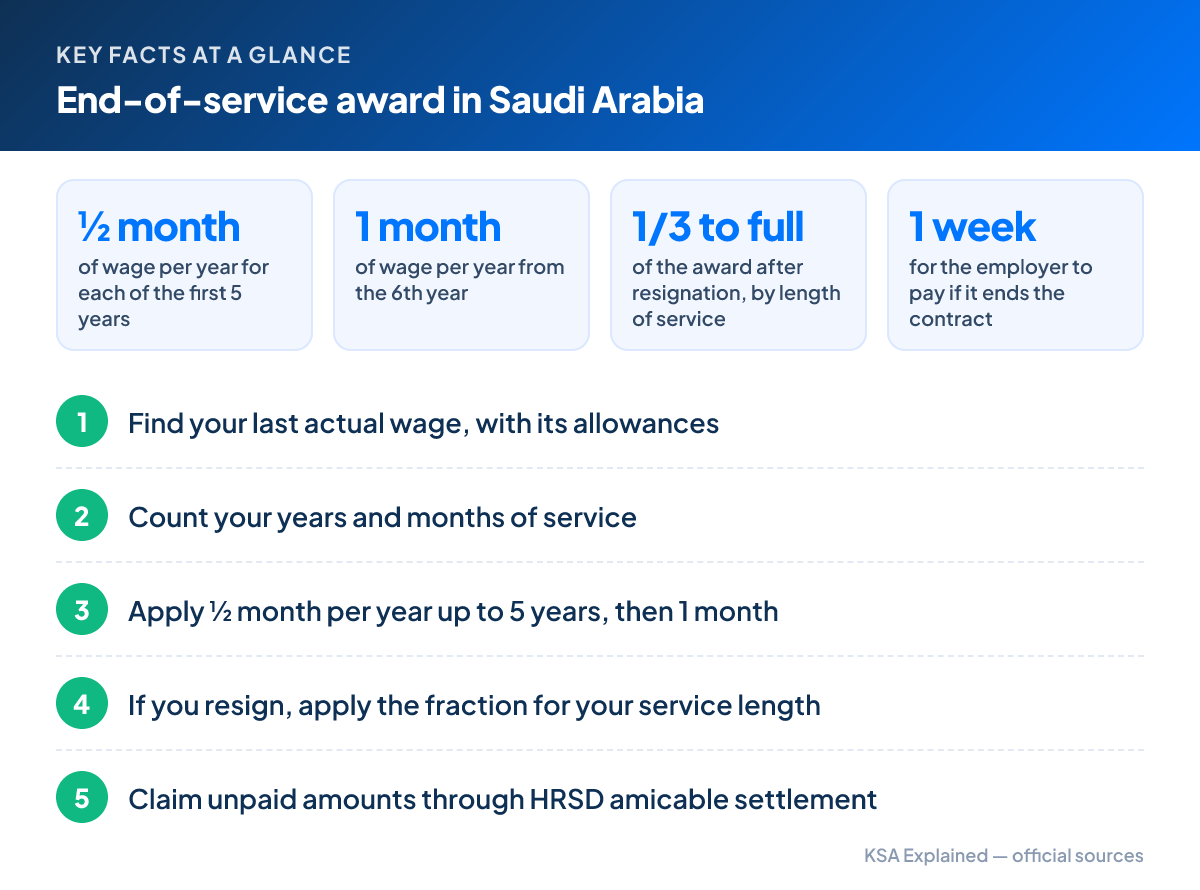
In short: you earn half a month’s wage per year for the first five years, then one month’s wage per year. If you resign, you get one third, two thirds or the full award depending on your length of service.
The award at a glance
| Situation | Award due |
|---|---|
| Employer ends the contract (or the contract reaches its end) | Full award |
| You resign after less than 2 years | Nothing |
| You resign after 2 to 5 years | One third |
| You resign after more than 5 and less than 10 years | Two thirds |
| You resign after 10 years or more | Full award |
| You leave because of force majeure | Full award |
| A female worker ends her contract within 6 months of marriage or 3 months of giving birth | Full award |
| Contract ended during probation | Nothing |
| Dismissal for one of the serious cases of Article 80 | Nothing |
The basic rule (Article 84)
When the employment relationship ends, the employer pays an award equal to:
- half a month’s wage for each of the first five years of service;
- one month’s wage for each following year.
The award is calculated on the last wage you received. Parts of a year count in proportion to the time worked: 3 years and 6 months count as 3.5 years. The Ministry of Human Resources and Social Development (HRSD) adds that the period counted includes all consecutive years of employment with the employer.
When a fixed-term contract is renewed, the renewal is treated as an extension of the original term for calculating rights linked to length of service (Article 56). Your years under successive renewals therefore add up.
Which wage is used?
Article 2 of the Labor Law defines the wage as the actual wage: the basic wage plus the increments decided for the worker under the contract or the work regulations. It lists in particular:
- commissions and percentages of sales or profits;
- allowances for effort or risks at work;
- increments linked to the cost of living or family expenses;
- grants or rewards provided for in the contract or customarily paid;
- in-kind benefits promised in the contract, valued at up to two months of basic wage per year unless the contract says more.
Article 86 makes one exception: the contract may provide that commissions, sales percentages and similar components that go up and down by nature are left out, in whole or in part. The Labor Law also counts a month as 30 days, unless the contract says otherwise.
Watch out: read the wage clause of your contract. If it excludes commissions, your award is calculated without them. If it says nothing, they are part of the wage.
Quick table
| Length of service | Award (if the employer ends the contract) |
|---|---|
| 1 year | 0.5 month’s wage |
| 2 years | 1 month’s wage |
| 3 years | 1.5 months’ wage |
| 5 years | 2.5 months’ wage |
| 7 years | 2.5 + 2 = 4.5 months’ wage |
| 10 years | 2.5 + 5 = 7.5 months’ wage |
| 15 years | 2.5 + 10 = 12.5 months’ wage |
| 20 years | 2.5 + 15 = 17.5 months’ wage |
If you resign (Article 85)
When the contract ends because you resign, the award is reduced:
| Length of service | Share of the award |
|---|---|
| Less than 2 consecutive years | Nothing |
| 2 to 5 years | One third |
| More than 5 and less than 10 years | Two thirds |
| 10 years or more | Full award |
The fraction applies to the award calculated with the basic rule. For example, after 7 years with a last wage of SAR 9,000, the full award is 4.5 months, so SAR 40,500. On resignation, you receive two thirds: SAR 27,000.
Since the 2025 amendments, resignation has its own procedure: written request, acceptance by the employer or automatic acceptance after 30 days. It is explained in our guide on resignation and notice period.
Tip: if you are close to a threshold (2, 5 or 10 years), check the exact date before resigning. A few weeks can change your award from nothing to one third, or from two thirds to the full amount.
When you get the full award even after leaving
Article 87 grants the full award in two cases, whatever your length of service:
- you leave because of force majeure beyond your control;
- a female worker ends her contract within six months of her marriage or within three months of giving birth.
Leaving without notice in the cases of Article 81 (for example when the employer does not pay you or assaults you) does not make you lose your legal rights: these cases are treated as a breach by the employer, not as an ordinary resignation.
Worked examples
Example 1: employer ends the contract after 4 years. Last wage SAR 6,000. Award = 4 × 0.5 × 6,000 = SAR 12,000.
Example 2: employer ends the contract after 8 years and 6 months. Last wage SAR 10,000.
| Part of service | Calculation | Amount |
|---|---|---|
| First 5 years | 5 × 0.5 × 10,000 | SAR 25,000 |
| Remaining 3.5 years | 3.5 × 1 × 10,000 | SAR 35,000 |
| Total | SAR 60,000 |
Example 3: resignation after 4 years. Last wage SAR 6,000. Full award SAR 12,000; one third due: SAR 4,000.
Example 4: resignation after 12 years. Last wage SAR 15,000. Full award = 2.5 + 7 = 9.5 months, so SAR 142,500. With 10 years or more, the full award is due: SAR 142,500.
Example 5: resignation after 18 months. No award is due, because service is under two years. You are still owed your unpaid wages and your unused annual leave.
Estimate yours with our end-of-service award calculator, or with the official HRSD calculator (link in the sources below).
When no award is due
- During the probation period: the Labor Law and the HRSD state that no end-of-service award is due if the contract ends during probation. See our guide on the probation period.
- Resignation before two years of continuous service.
- Dismissal under Article 80. The employer may end the contract without award, notice or compensation only in these cases, and only after giving the worker a chance to object:
- assault on the employer, the manager or a superior, during or because of work;
- failure to perform the main obligations of the contract or to obey legitimate orders, or deliberate breach of posted safety instructions despite written warnings;
- misconduct or an act against honesty or integrity;
- a deliberate act or omission intended to cause material loss to the employer, reported to the authorities within 24 hours;
- forgery to obtain the job;
- absence without valid reason for more than 30 days in a contract year or more than 15 consecutive days, after a written warning at 20 days or 10 days of absence;
- using the position unlawfully for personal gain;
- disclosing trade secrets.
Watch out: outside these cases, a dismissal without award is unlawful. A vague accusation is not enough: the employer must be able to prove the facts and must have heard your objections.
What else you are owed when the contract ends
The award is only one part of your final settlement. You are also entitled to:
- your unpaid wages up to the last day;
- the wage for your unused annual leave, and leave pay in proportion for the part of the year worked (Article 111). See annual leave in Saudi Arabia;
- compensation if the contract was ended without a valid reason or without the notice period: 15 days’ wage per year of service for an indefinite contract, the wage for the remaining term for a fixed-term contract, and at least two months’ wage in all cases (Article 77);
- a free service certificate stating your start date, end date, profession and last wage;
- for expatriates, the return ticket to your home country, which the employer bears under Article 40, unless you are unfit for work or leave without a valid reason.
Payment deadline (Article 88)
- If the employer ends the contract: wages and entitlements must be paid within one week.
- If the worker ends the contract: within two weeks.
The employer may deduct work-related debts owed to it. Deductions from wages are otherwise strictly limited by the Labor Law.
Domestic workers: a different rule
Domestic workers (drivers, housekeepers and other workers employed by a household) are covered by their own regulations, not by Article 84. The HRSD states that a domestic worker receives one month’s wage for every four consecutive years of service, based on the last wage, paid when the contract ends. The same payment deadlines apply: one week if the employer ends the contract, two weeks if the worker does.
If your employer does not pay
- Ask for a written settlement listing your award, unpaid wages and leave, and check it against the rules above.
- Do not sign a receipt for amounts you have not actually received. The HRSD warns that signing without checking may affect your ability to claim later.
- File an amicable settlement request with the Ministry. It is free, filed electronically with the settlement office of the city where you last worked, and handled within about 21 working days: the parties first get a week to negotiate directly, then a mediation session is held.
- Go to the labor court through the Najiz platform if no agreement is reached. The settlement office refers the case.
Watch out: labor courts do not hear claims filed more than 12 months after the end of the employment relationship (Article 234), unless the court accepts a justification or the employer admits the debt. Do not wait.
Expatriates should settle these questions before their final exit visa is used: once you have left, following up is much harder.
Common mistakes
- Using the basic salary only: the award is based on the actual wage defined by Article 2, unless the contract excludes variable components.
- Forgetting partial years: months worked after the last full year count in proportion.
- Confusing resignation and termination: the reduced fractions apply only when you resign.
- Resigning just before a threshold: 2, 5 and 10 years change the fraction you receive.
- Waiting too long to claim: the 12-month limit runs from the end of the contract.
Frequently asked questions
How is the end-of-service award calculated in Saudi Arabia?
Article 84 of the Labor Law gives half a month's wage for each of the first five years of service and one month's wage for each following year. It is based on the last wage, and parts of a year count in proportion.
Do I get end-of-service if I resign?
Yes, if you have at least two consecutive years of service. You receive one third of the award for 2 to 5 years, two thirds for more than 5 and less than 10 years, and the full award from 10 years.
Do I get the award if I am dismissed?
Yes, the full award is due when the employer ends the contract, except in the cases of Article 80 of the Labor Law (serious misconduct such as assault, forgery or disclosure of secrets), after the worker has been allowed to object.
Is end-of-service paid during the probation period?
No. The Ministry of Human Resources states that a worker is not entitled to an end-of-service award if the contract is ended during the probation period.
When must the employer pay the end-of-service award?
Within one week of the end of the contract when the employer ends it, and within two weeks when the worker ends it (Article 88).
How long do I have to claim my end-of-service award?
Labor courts do not hear claims filed more than 12 months after the end of the employment relationship, unless the court accepts a justification or the employer admits the right. Start with the free amicable settlement service of the Ministry.
Do domestic workers get the same end-of-service award?
No. Domestic workers have their own regulations: one month's wage for every four consecutive years of service, based on the last wage.
Official sources
- Ministry of Human Resources and Social Development — Labor Law (English translation): Articles 2 (definition of wage), 56, 77, 80, 81, 84 to 88, 111 and 234.
- HRSD — Awareness guide on the rights and duties of employers and workers: award table on resignation, no award during probation, compensation, service certificate, amicable settlement and Najiz.
- HRSD — Amendments to Labor Law articles: Article 40 (costs borne by the employer, including the return ticket).
- HRSD — Friendly settlement for labor disputes: steps, one week of direct negotiation, 21 working days, free service, 12-month condition.
- HRSD — End of service benefits for domestic workers: one month per four years, payment deadlines.
- HRSD — End of Service Benefit Calculator: official calculator.
This information is for guidance only and may change. Always check with the relevant authority or its official website before starting a procedure. Spotted an error? Tell us.