


Working hours in Saudi Arabia are set by the Labor Law and explained in the 2025 awareness guide of the Ministry of Human Resources and Social Development (HRSD). The rules cap daily and weekly hours, reduce them during Ramadan for Muslim workers, guarantee breaks and a weekly rest day, and set how overtime is paid. Since the 2025 amendments, overtime can also be compensated with paid time off. This guide also covers when and how wages must be paid, and the limits on salary deductions.
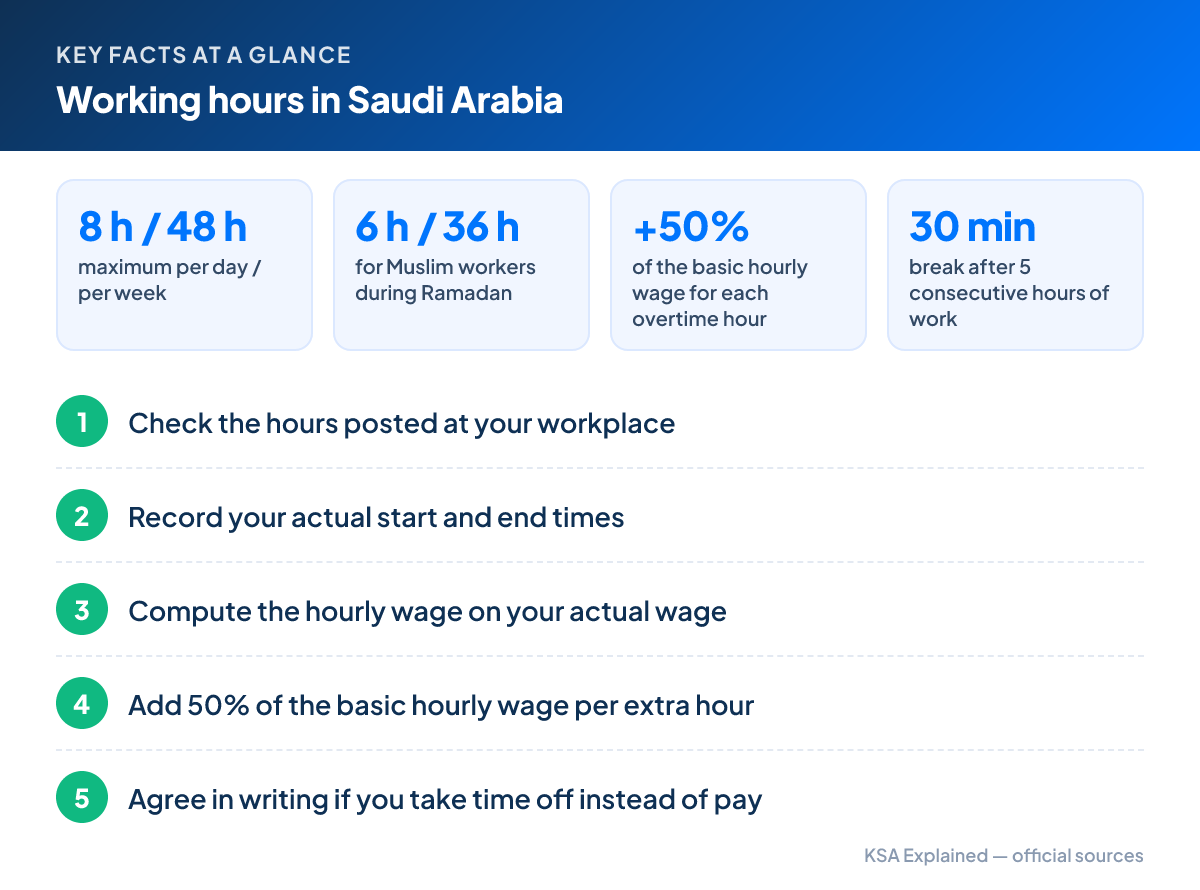
In short: at most 8 hours a day or 48 hours a week, and 6 hours a day or 36 a week in Ramadan for Muslims. Each overtime hour is paid at your hourly wage plus 50% of your basic hourly wage.
Normal working hours
| Period | Maximum |
|---|---|
| Per day | 8 hours |
| Per week | 48 hours |
| Per day in Ramadan (Muslim workers) | 6 hours |
| Per week in Ramadan (Muslim workers) | 36 hours |
The employer works with either a daily or a weekly standard. If it uses a weekly standard, every hour above the weekly hours it adopted counts as overtime (Article 107).
The employer must post in a visible place at the workplace:
- the working hours schedule;
- the rest periods;
- the start and end of each shift, if work is organised in shifts.
Tip: take a photo of the posted schedule. If a dispute about overtime arises, it shows the official hours against which extra hours are counted.
Breaks
- A break of at least 30 minutes after every five consecutive hours of work.
- Rest, prayer and meal breaks are not counted in working hours.
- During breaks, you are not under the employer’s authority, and the employer cannot require you to stay at the workplace.
Example. You work from 8:00 to 17:00 with a one-hour lunch break. You are at work for 9 hours but your working time is 8 hours: the break does not count.
Weekly rest day
You are entitled to a weekly rest day that cannot be replaced by money. Friday is the rest day for all workers, unless another day is agreed and the relevant labor office is notified, provided you can still perform your religious duties. Your contract may give more rest days.
Working hours during Ramadan
During the holy month of Ramadan, the working hours of Muslim workers are reduced to 6 hours a day or 36 hours a week. The reduction applies to Muslims; the law does not set a reduction for other workers.
If a Muslim worker works more than these reduced hours in Ramadan, the extra hours are overtime.
Example. In Ramadan, a Muslim employee on a daily standard works 8 hours on a given day. The 2 hours beyond the 6-hour limit are overtime.
How overtime is paid
Article 107 sets the rate: the hourly wage plus 50% of the basic hourly wage.
- The hourly wage is calculated on the actual wage (basic wage plus allowances and bonuses).
- The 50% premium is calculated on the basic wage only. The HRSD notes that allowances such as housing or transport are not included in that basis, unless the contract or the internal regulations say otherwise.
Worked example (from the HRSD guide)
Sarah earns a basic wage of SAR 4,000 and an actual wage of SAR 6,000 with allowances. She works 3 extra hours.
| Step | Calculation | Result |
|---|---|---|
| Hourly wage (actual wage) | 6,000 ÷ 30 ÷ 8 | SAR 25 |
| Basic hourly wage | 4,000 ÷ 30 ÷ 8 | SAR 16.67 |
| Overtime hour | 25 + (16.67 × 50%) | SAR 33.33 |
| 3 overtime hours | 33.33 × 3 | about SAR 100 |
More examples
| Basic wage | Actual wage | Hourly wage | Basic hourly wage | One overtime hour | 10 overtime hours |
|---|---|---|---|---|---|
| SAR 3,000 | SAR 4,200 | SAR 17.50 | SAR 12.50 | SAR 23.75 | SAR 237.50 |
| SAR 6,000 | SAR 8,400 | SAR 35 | SAR 25 | SAR 47.50 | SAR 475 |
| SAR 10,000 | SAR 14,000 | SAR 58.33 | SAR 41.67 | SAR 79.17 | SAR 791.67 |
These figures use the same method as the HRSD example: 30 days a month and 8 hours a day. Do the calculation for your own wage with our overtime calculator.
Holidays
All hours worked on official holidays (Eid al-Fitr, Eid al-Adha, National Day, Founding Day) count as overtime. See public holidays in Saudi Arabia.
Time off instead of overtime pay
Since the 2025 amendments to the Labor Law, the employer may, with your consent, give you paid compensatory leave instead of overtime pay. The HRSD guide sets the conditions:
- at least one and a half hours of leave for each overtime hour;
- the leave must be used within 60 days of the overtime, unless agreed otherwise;
- compensatory leave cannot exceed 30 days a year.
Example. You work 8 overtime hours and agree to time off. You are owed at least 12 hours of paid leave, to be taken within 60 days.
Watch out: without your agreement, the employer must pay the overtime in money. Get any agreement on compensatory leave in writing.
When and how wages are paid
Article 90 sets the rhythm of payment:
| Type of pay | Paid at least |
|---|---|
| Monthly wage | Once a month |
| Daily wage | Once a week |
| Piece work taking more than two weeks | Weekly payment in proportion to the work done, balance the week after delivery |
| Other cases | Once a week |
Wages are paid in riyals and deposited into the worker’s bank account. The payday is set in the contract or the internal work regulations. Employers must also record and pay wages through the Wage Protection Program, which lets the Ministry check that workers are paid on time; failing to comply is a violation.
Tip: the HRSD advises never to sign for a payment before actually receiving it. Signing without checking may weaken a later claim.
Deductions from your salary
Without your written consent, the employer may deduct only in the cases listed by Article 92, including:
- repayment of a loan from the employer, up to 10% of the wage;
- social insurance and other contributions provided by law;
- fines for violations under the work regulations, and damages you caused;
- a debt under a court judgment, up to one quarter of the monthly wage unless the judgment says otherwise.
For damage to the employer’s equipment caused by your own fault, Article 91 caps the deduction at five days’ wage per month, and you can challenge it before the labor court within 15 working days of being notified.
In all cases, total deductions may not exceed half of the wage due, unless the labor court decides otherwise (Article 93).
If the employer deducts without a legal basis or delays wages without a valid reason, the labor court can order repayment and fine the employer up to twice the amount concerned (Article 94).
If your employer does not respect the rules
- Keep a record of your hours (start, end, breaks) and your payslips.
- Raise the issue internally: employers must have a grievance procedure.
- If unresolved, use the free HRSD amicable settlement service for labor disputes.
- Without agreement, the case can go to the labor court through the Najiz platform. Claims must be brought within 12 months of the end of the employment relationship (Article 234).
Common mistakes
- Calculating overtime on the basic wage only: the hourly wage part uses the actual wage; only the 50% premium uses the basic wage.
- Counting prayer and meal breaks as working time: they are excluded.
- Taking time off for overtime without a written agreement: the compensatory leave needs your consent.
- Accepting deductions above half the wage: the law caps them, except by court decision.
Related guides: annual leave, end-of-service award.
Frequently asked questions
What are the legal working hours in Saudi Arabia?
The Ministry of Human Resources states a maximum of 8 hours a day or 48 hours a week. Rest, prayer and meal breaks are not counted as working time.
What are working hours during Ramadan?
For Muslim workers, working hours are reduced to 6 hours a day or 36 hours a week during the month of Ramadan.
How is overtime calculated in Saudi Arabia?
Each overtime hour is paid at the hourly wage plus 50% of the basic hourly wage. Working on official holidays counts entirely as overtime.
Can I get time off instead of overtime pay?
Yes, if you agree. Since the 2025 amendments, the employer may give paid compensatory leave: at least one and a half hours of leave per overtime hour, to be used within 60 days, up to 30 days a year.
Is Friday a day off in Saudi Arabia?
Friday is the weekly rest day for all workers unless another day is agreed and the labor office is notified. The weekly rest day cannot be replaced by cash.
When must my salary be paid in Saudi Arabia?
A monthly-paid worker is paid once a month and a daily-paid worker at least once a week, into a bank account, on the date set in the contract or the internal work regulations (Article 90).
How much can my employer deduct from my salary?
Deductions without your written consent are limited to the cases listed in Article 92, such as loan repayments (up to 10% of the wage) or social insurance. In all cases, total deductions may not exceed half of the wage due, unless the labor court decides otherwise.
Official sources
- Ministry of Human Resources and Social Development — Awareness guide on the rights and duties of employers and workers: 8/48 hours, Ramadan 6/36 hours, breaks, weekly rest, overtime example, compensatory leave, Wage Protection Program, advice on signing for payments.
- HRSD — Amendments to Labor Law articles: new Article 107 (overtime, compensatory leave, holidays).
- HRSD — Labor Law (English translation): Articles 90 to 94 (payment of wages and deductions) and 234 (12-month limit for claims).
- HRSD — Friendly settlement for labor disputes: free amicable settlement before the labor court.
This information is for guidance only and may change. Always check with the relevant authority or its official website before starting a procedure. Spotted an error? Tell us.