

Resigning in Saudi Arabia follows precise rules since the 2025 amendments to the Labor Law, which added a new Article 79 bis on resignation and changed the notice periods of Article 75. The rules differ between fixed-term and indefinite contracts, and leaving the wrong way can cost you compensation or part of your end-of-service award. This guide explains the notice periods, the new resignation procedure, what you are owed, the cases where you can leave without notice, and what an expatriate must do next.
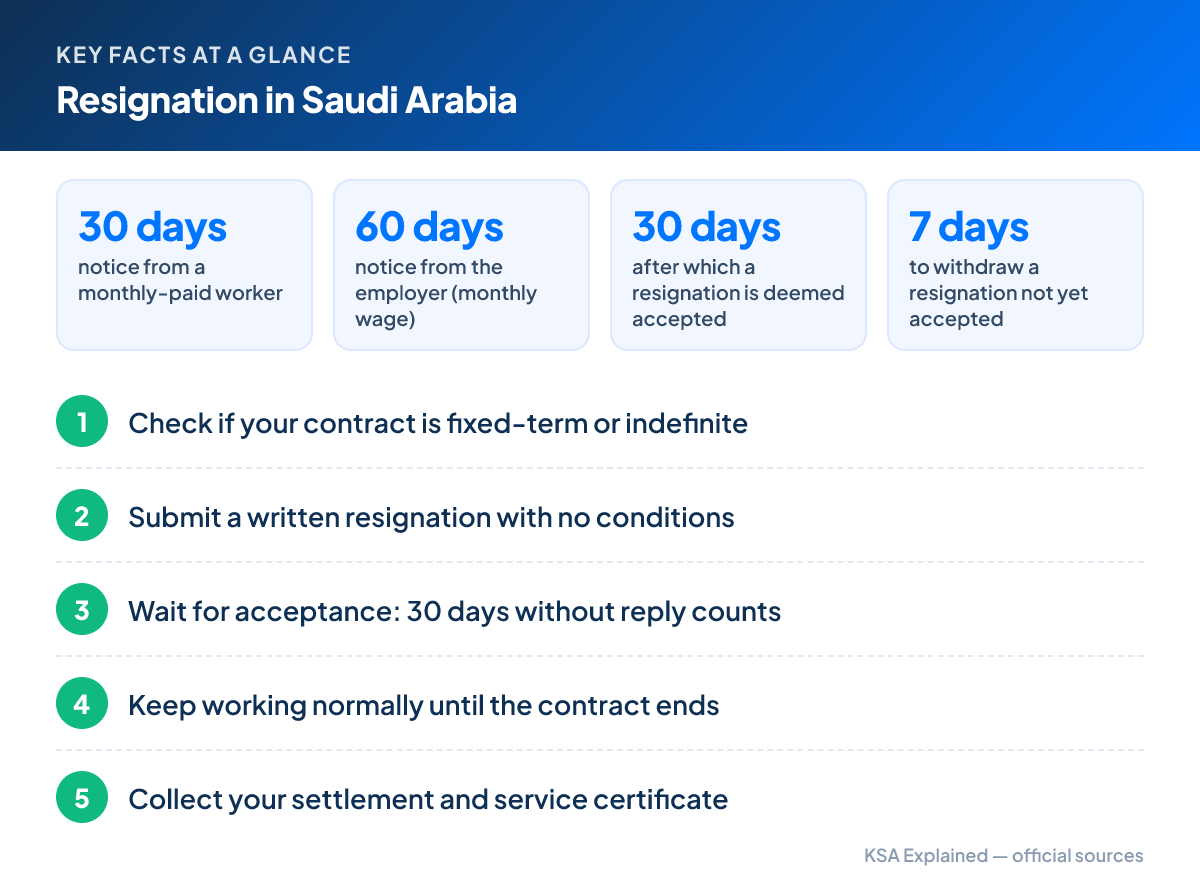
In short: a monthly-paid worker gives 30 days’ notice, the employer 60 days. A resignation is deemed accepted after 30 days without reply, and you can withdraw it within 7 days if it has not been accepted.
Fixed-term or indefinite contract?
The rules depend on your contract:
| Fixed-term contract | Indefinite contract | |
|---|---|---|
| How it ends | On its end date, unless renewed | By either party, for a valid reason, with written notice |
| Leaving early | Resignation accepted by the employer, or the cases of Article 81 | Notice period of Article 75, or resignation |
| Compensation if ended unlawfully | Wage for the remaining term (minimum 2 months) | 15 days’ wage per year of service (minimum 2 months) |
The HRSD defines resignation as the worker’s written wish, made without coercion, to end a fixed-term contract, without any condition or restriction, followed by the employer’s acceptance.
Expatriates: usually a fixed-term contract
The contract of a non-Saudi worker must be written and fixed-term. If it states no duration, it is deemed to be one year from the start of work, and it renews automatically for the same period if both parties continue. All employment contracts must now be written on the Ministry’s unified model and documented on the Qiwa platform; each party keeps a copy.
Notice periods (Article 75)
For an indefinite contract ended for a valid reason:
| Wage paid | Notice from the worker | Notice from the employer |
|---|---|---|
| Monthly | At least 30 days | At least 60 days |
| Not monthly | At least 30 days | At least 30 days |
The notice must be in writing. Your contract can set longer periods.
If the notice is not respected
Article 76: the party that ends an indefinite contract without respecting the notice must pay the other party the wage for the notice period, unless they agreed on a higher amount.
Example. You earn SAR 7,000 a month and your employer ends your indefinite contract without the 60 days’ notice. It owes you two months’ wage, SAR 14,000, in addition to your other rights.
Time off to look for a job
When the employer gives notice, Article 78 gives you a paid day off or 8 hours per week to look for another job. You choose the time and tell the employer at least one day ahead. The employer may also release you from work during the notice period without affecting your length of service or your pay for that period.
How resignation works (Article 79 bis)
- Submit a written resignation. It must not contain conditions, and you cannot set a deferred date of resignation in the request.
- The employer answers. If there is no reply within 30 days, the resignation is considered accepted.
- Postponement. If work requires it, the employer can postpone acceptance for up to 60 days, with a written explanation given to you before the 30 days end. The 60 days run from the date of that explanation.
- Withdrawal. You can withdraw the resignation within 7 days of submitting it, unless the employer has already accepted it.
- During the waiting period, the contract stays in force: you keep working and are paid, and both parties keep all their obligations.
- End of the contract. It ends when the employer accepts, when the 30 days pass without reply, or when the postponement period ends.
A worker whose contract ends by resignation keeps all the rights provided by the Labor Law.
Timeline example
| Date | Event |
|---|---|
| 1 March | You submit your written resignation |
| 8 March | Last day to withdraw it, if not yet accepted |
| 31 March | Without a reply, the resignation is deemed accepted: the contract ends |
| If the employer postponed on 20 March | The contract can run up to 60 days from 20 March |
What to put in your resignation letter
- Your name, Iqama or ID number, job title and employer.
- A clear statement that you resign, without conditions and without a future date.
- The date of the letter and your signature.
Submit it through the channel your employer uses (HR system, email, letter) and keep proof of the date.
What you are owed after resigning
- End-of-service award, reduced according to your service: one third (2 to 5 years), two thirds (more than 5 and less than 10 years) or full (10 years or more). Nothing under two years. A female worker who resigns within six months of her marriage or three months of giving birth keeps the full award. Details in our guide on the end-of-service award; estimate it with the end-of-service calculator.
- Your unpaid wages and the wage for your unused annual leave: see annual leave.
- Payment within two weeks of the end of the contract when the worker ends it (Article 88).
- A free service certificate showing your start date, end date, profession and last wage, with nothing offensive in it, and the return of any documents you deposited.
For expatriates, the employer bears the return ticket to the home country (Article 40), except if the worker is unfit for work or ends the contract without a valid reason: the worker then pays for the trip home.
Leaving without notice while keeping your rights (Article 81)
You can leave without notice and keep all your legal rights if:
- the employer does not fulfil its essential contractual or legal obligations toward you (for example, unpaid wages);
- the employer used fraud about the work conditions when you were hired;
- you are assigned, without your consent, work fundamentally different from the agreed work;
- the employer, a member of its family or the manager commits violence or an immoral act against you or your family;
- you are treated with cruelty, injustice or insult;
- there is a serious hazard at work that the employer knows about and does not remove;
- the employer’s unjust treatment or breach of contract pushes you to leave, to make you appear as the party ending the contract.
Watch out: keep evidence (unpaid payslips, messages, witness names) before leaving under Article 81. If the employer disputes it, you will need to prove the facts in an amicable settlement or before the labor court.
If the employer ends the contract unlawfully
If a contract is ended without a valid reason, and the contract does not set the compensation, Article 77 and the HRSD guide give:
| Contract | Compensation |
|---|---|
| Indefinite | 15 days’ wage for each year of service |
| Fixed-term | Wage for the remaining period of the contract |
| Minimum in all cases | 2 months’ wage |
This compensation comes on top of the end-of-service award and the other dues.
Expatriates: next steps
After your contract ends, you either:
- move to a new employer through the job transfer service on the Qiwa platform, the new employer bearing the transfer costs (Article 40); or
- leave the country with a final exit visa, issued by your employer or, after the contract ends, requested by you through Absher or Qiwa.
Settle your dues, your traffic violations and any car registered in your name before leaving.
Claims and deadlines
- Start with your company’s internal grievance procedure.
- File a free amicable settlement request with the Ministry: one week of direct negotiation, then mediation, about 21 working days in total.
- Without agreement, the case goes to the labor court through Najiz.
Labor courts do not hear claims filed more than 12 months after the end of the employment relationship (Article 234).
Common mistakes
- Writing a resignation with a future date: the law no longer allows a deferred date in the request.
- Stopping work after submitting: the contract stays in force until it ends; absence can be held against you.
- Leaving an indefinite contract without notice: you may owe the employer the wage for the notice period.
- Leaving without the service certificate: ask for it, it is free.
Frequently asked questions
What is the notice period for resignation in Saudi Arabia?
For an indefinite contract with a monthly wage, the worker must give at least 30 days' written notice and the employer at least 60 days. If the wage is not paid monthly, the notice is at least 30 days for both.
What happens if my employer does not answer my resignation?
Since the 2025 amendments, a resignation is considered accepted if 30 days pass after it is submitted without a reply from the employer.
Can my employer refuse or delay my resignation?
The employer can postpone acceptance for up to 60 days if work requires it, with a written explanation given before the 30-day period ends. It cannot block the resignation indefinitely.
Can I withdraw my resignation?
Yes, within seven days of submitting it, as long as the employer has not already accepted it.
Do I lose my end-of-service award if I resign?
Not entirely. After 2 to 5 years you get one third, after more than 5 and less than 10 years two thirds, and after 10 years the full award.
What happens if I leave without serving my notice?
Under Article 76, the party that ends an indefinite contract without respecting the notice period owes the other party the wage for the notice period, unless a higher amount was agreed.
Do I get time off to look for a new job during my notice?
Yes, if the employer gave the notice. Article 78 gives the worker a paid day off, or 8 hours, each week to look for another job, with one day's warning to the employer.
Official sources
- Ministry of Human Resources and Social Development — Amendments to Labor Law articles: new Articles 40 (costs borne by the employer), 51 and 52 (written contract on the unified model), 75 (notice periods) and 79 bis (resignation).
- HRSD — Awareness guide on the rights and duties of employers and workers: contract types, contracts of non-Saudi workers, resignation, compensation for unlawful termination, leaving without notice, service certificate, return ticket.
- HRSD — Labor Law (English translation): Articles 76, 77, 78, 81, 85, 87, 88 and 234.
- HRSD — Friendly settlement for labor disputes: free amicable settlement, timeline and conditions.
This information is for guidance only and may change. Always check with the relevant authority or its official website before starting a procedure. Spotted an error? Tell us.