


An expatriate who leaves Saudi Arabia for good needs a final exit visa. Once used, the Iqama ends and the person cannot come back on it. Before the visa is issued, several conditions must be met, and once you have left, it is much harder to recover money or close files. This guide gives the conditions, who issues the visa, the costs, and a complete checklist of what to settle before leaving.
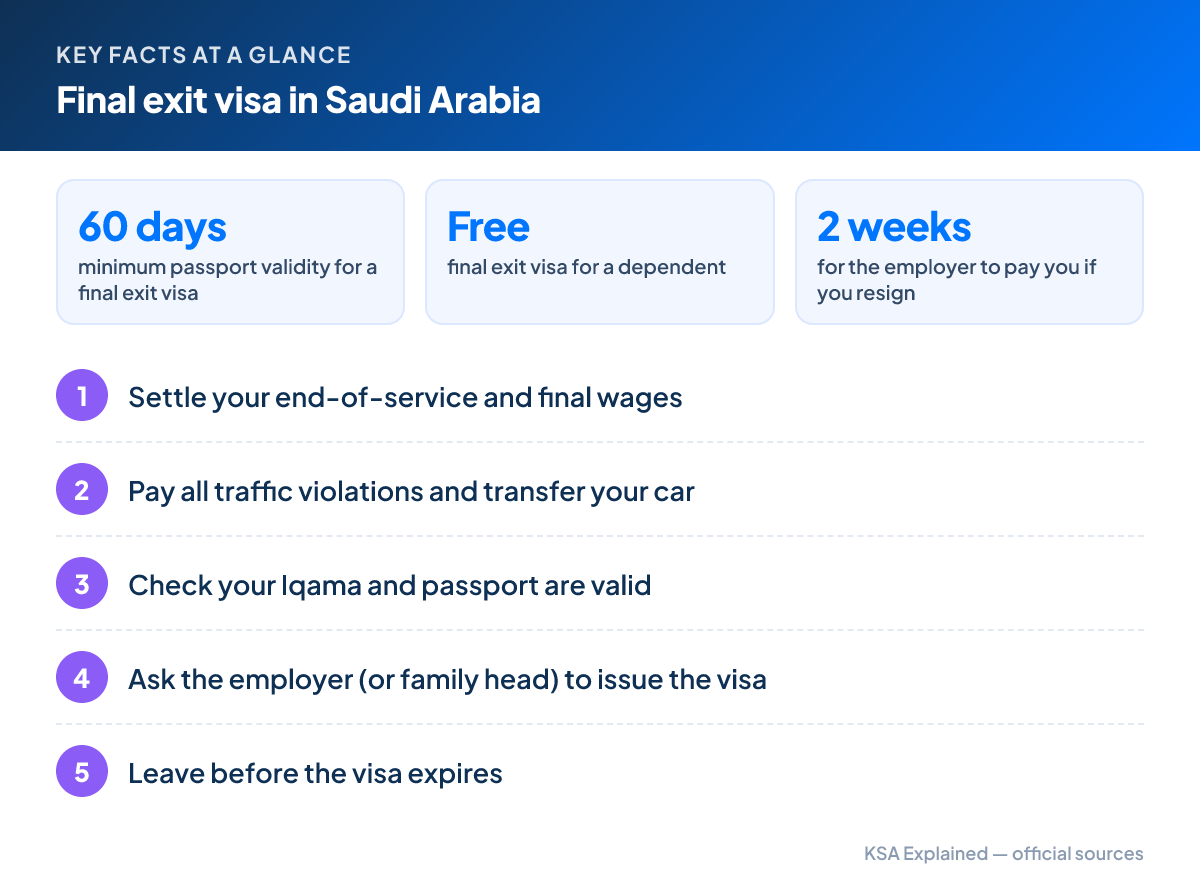
In short: your Iqama must be valid, your passport valid for 60 days, your traffic violations paid and no car registered in your name. For a worker, the employer issues it, or the worker requests it after the contract ends; for a dependent, it is free.
Who issues the visa?
| Person leaving | Who issues the final exit visa | Where |
|---|---|---|
| Worker | The employer, or the worker after the contract ends (employer notified) | Employer’s platforms, or Absher app and Qiwa |
| Family member (dependent) | The head of family | Absher Individuals, Family Members services |
| Domestic worker | The employer | Absher Individuals, Workers services |
If your contract ends and you are not moving to another employer, ask HR to issue the visa, or request it yourself (see below).
Conditions
The Absher user guide lists these conditions for the final exit visa:
- the person is inside Saudi Arabia;
- the Iqama is valid;
- the passport is valid for at least 60 days;
- all traffic violations of the person, and of the employer or family head, are paid;
- no vehicle is registered in the person’s name;
- fingerprints are registered (from 15 years old);
- there is no previous violation for failing to cancel an unused visa.
Fees
- The national platform states that a final exit visa for a dependent is free.
- For a worker, Article 40 of the Labor Law makes the employer bear the exit fees and the return ticket to the home country. The worker pays the trip home only if they are unfit for work or leave the contract without a valid reason.
Leaving at the end of your contract
Since the Labor Reform Initiative took effect on 14 March 2021, an expatriate worker can leave Saudi Arabia after the end of the employment contract without the employer’s consent. The request goes through the Absher app or Qiwa, and the employer is notified electronically.
Watch out: the Ministry states that a worker who leaves while breaking the contract bears all the consequences of that breach. Wait for the end of the contract, or follow the resignation and notice rules, before leaving.
Changing employer instead of leaving
If you want to stay in Saudi Arabia with another employer, you do not need a final exit visa:
| Step | Detail |
|---|---|
| 1 | The new employer sends you a job offer on Qiwa |
| 2 | You log in and accept (or reject) the offer |
| 3 | Your current employer is notified |
| 4 | The system checks the requirements; once approved, your data is updated and a new work permit is issued |
The Ministry’s transfer of services (freedom of movement) service lets a resident employee move to a new employer without the current employer’s approval, subject to the regulations. It is free and processed immediately. Under the 2021 reform, transfer without consent applies at the end of the binding contract; during the contract, the notice period and the rules of the Labor Law apply. The Ministry’s procedural guide also mentions a condition of at least 12 continuous months in the Kingdom before the contract ends.
Under Article 40 of the Labor Law, the new employer bears the cost of transferring your services.
Checklist before leaving
1. Work and money
- Final settlement: unpaid wages, unused annual leave and end-of-service award. If you resign, the employer has two weeks to pay; if the employer ends the contract, one week.
- Do not sign a receipt for amounts you have not received.
- Service certificate: the employer must give it to you free of charge, with your start and end dates, profession and last wage.
- Notice and resignation: follow the rules, see resignation and notice period.
Watch out: if your employer does not pay, file an amicable settlement request with the Ministry of Human Resources before you leave. Labor courts do not hear claims filed more than 12 months after the end of the contract.
2. Car and traffic
- Pay all traffic violations on Absher: see traffic violations.
- Sell or transfer any vehicle registered in your name, with Absher’s Vehicle Ownership Transfer service: the visa cannot be issued otherwise.
- Cancel any driving authorisation you gave others for your vehicles.
3. Family
- Issue final exit visas for your dependents too if they leave with you (free).
- Settle any dependent fees already due.
- Check that every family member has a passport valid for at least 60 days.
4. Phone lines and contracts
- Check the mobile numbers and data SIMs registered with your Iqama with the free CST service, and cancel those you no longer use: see numbers registered in your name.
- Close or settle your contracts: housing, utilities, internet, loans.
5. Documents
- Keep copies of your Iqama, contract, payslips, settlement and service certificate.
- Note the reference numbers of any pending complaint or claim.
Timeline example
| When | What to do |
|---|---|
| 2 months before | Check passports, Iqamas and contract end date; tell your employer |
| 1 month before | Sell the car, pay traffic violations, list phone lines and contracts to close |
| 2 weeks before | Agree the final settlement with your employer; collect the service certificate |
| 1 week before | Employer (or head of family) issues the final exit visas |
| Departure | Leave before the visa expires |
Final exit during probation
For domestic workers, Absher has a dedicated service to issue a final exit visa during the probation period. The Absher guide lists conditions: the worker is not registered as deceased, absent or outside the Kingdom, there are no unpaid traffic violations, the passport is valid for at least 60 days, and the employer has no more than 100 domestic and non-domestic workers. For other workers, the contract may be ended during probation without compensation, then the final exit visa is issued. See probation period.
Cancelling a final exit visa
If plans change, the visa can be cancelled on the same platforms while the person is still in the Kingdom, within 90 days of issue or before the return date. Beyond that, fines apply. Fees are not refunded.
Final exit or exit re-entry?
| You plan to… | Visa |
|---|---|
| Travel and come back on the same Iqama | Exit re-entry visa |
| Leave for good | Final exit visa |
| Change employer and stay | No visa: job transfer on Qiwa |
After you have left
- A claim against your former employer can still go through the Ministry’s amicable settlement service, which accepts a representative with a power of attorney authorised to attend and settle.
- Keep the 12-month limit in mind for labor court claims.
Common mistakes
- A car still registered in your name: the visa cannot be issued until it is sold or transferred.
- Unpaid traffic violations, including those of the employer or the head of family.
- Leaving before being paid: following up from abroad is slow and needs a representative.
- Mobile lines left active in your name.
Frequently asked questions
What are the conditions for a final exit visa?
According to the Absher guide: the person is inside Saudi Arabia, the Iqama is valid, the passport is valid for at least 60 days, all traffic violations are paid, no vehicle is registered in their name and fingerprints are registered.
Can I get a final exit visa with a car in my name?
No. The person must not have a vehicle registered in their name when the final exit visa is issued. Sell or transfer the car first.
Is the final exit visa free for dependents?
Yes. The national platform states that issuing a final exit visa for a dependent is free.
Who issues the final exit visa for a worker?
The employer, through its business platforms. For family members, the head of family issues it on Absher.
Can a final exit visa be cancelled?
Yes, while the person is still in Saudi Arabia, within 90 days of issue. Otherwise fines apply.
Can I claim my end-of-service award after leaving Saudi Arabia?
Yes, but it is harder. The amicable settlement service accepts a representative holding a power of attorney, and labor courts do not hear claims filed more than 12 months after the contract ends. Settle your dues before leaving whenever possible.
What happens to the mobile lines in my name when I leave?
They stay registered to your ID until cancelled. Check them with the free CST service Inquire about my numbers and cancel them with each provider before your final exit.
Can I leave Saudi Arabia at the end of my contract if my employer refuses?
Yes. Since the Labor Reform Initiative of 14 March 2021, an expatriate worker can leave after the end of the employment contract without the employer's consent, through the Absher app or Qiwa; the employer is notified electronically.
Can I change employer instead of leaving?
Yes. The Ministry's transfer of services service on Qiwa lets a resident employee move to a new employer without the current employer's approval, subject to its conditions. The new employer sends an offer, you accept it, and a new work permit is issued. The service is free.
Official sources
- Absher — Individuals e-services user guide (2022): conditions of the final exit visa, cancellation within 90 days, final exit during probation for domestic workers.
- Absher — Passport services: issuance and cancellation of final exit visas.
- Absher — Traffic services: Vehicle Ownership Transfer, driving authorisations.
- GOV.SA — Issuing final exit visa to dependent: free for a dependent.
- Ministry of Human Resources and Social Development — Amendments to Labor Law articles: Article 40, exit fees and return ticket borne by the employer.
- HRSD — Labor Law (English translation): Articles 88 (payment deadlines) and 234 (12-month limit).
- HRSD — Friendly settlement for labor disputes: representative with power of attorney.
- Communications, Space and Technology Commission — Inquire about my numbers: numbers and data SIMs registered with your ID.
- Ministry of Human Resources and Social Development — Labor Reform Initiative: final exit after the end of the contract without the employer’s consent, job mobility, in force from 14 March 2021.
- HRSD — Transfer of services from another employer (freedom of movement): steps on Qiwa, free, immediate.
This information is for guidance only and may change. Always check with the relevant authority or its official website before starting a procedure. Spotted an error? Tell us.