
An expatriate living in Saudi Arabia needs an exit re-entry visa to travel abroad and come back on the same Iqama. The visa is issued electronically by the General Directorate of Passports (Jawazat), through Absher for individuals and families, and through the employer’s platforms for workers. This guide explains who issues the visa, the conditions, the fees, the steps on Absher, how to extend it from abroad and how to cancel an unused visa.
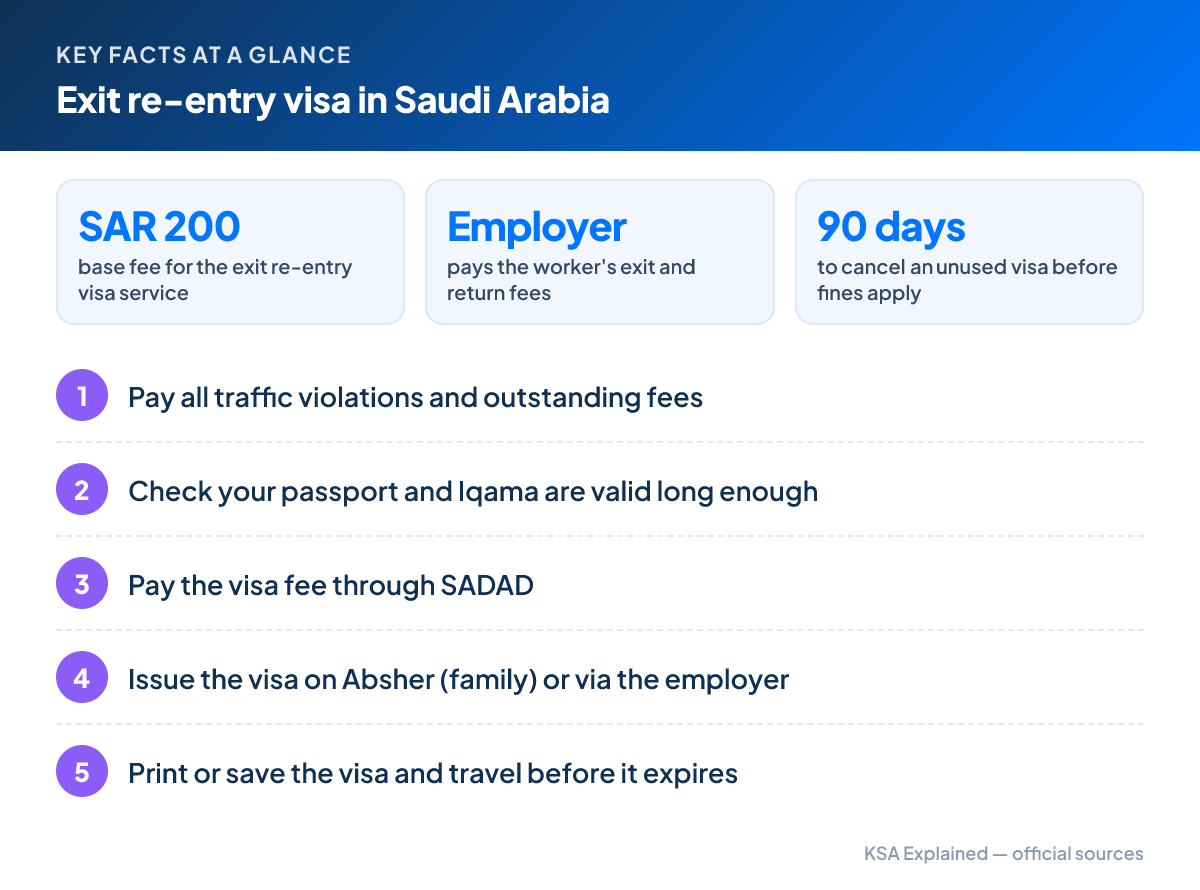
In short: the national platform lists a SAR 200 base fee. For a worker, the employer pays the exit and return fees. Before issuing it, your traffic violations must be paid and your passport and Iqama must be valid.
Who issues the visa?
| Traveller | Who issues the visa | Where |
|---|---|---|
| Worker (employee) | The employer, or the worker on request (employer notified) | Employer’s platforms, or Absher app and Qiwa |
| Family members (dependents) | The head of family | Absher Individuals, Family Members services |
| Domestic workers | The employer | Absher Individuals, Workers services |
Since the Labor Reform Initiative took effect on 14 March 2021, an expatriate worker can travel abroad without the employer’s approval after submitting a request, through the Absher app or Qiwa; the employer receives an electronic notification of the departure. Many workers still go through HR, as the employer bears the fees. Either way, plan the trip together with your annual leave request: the visa does not give you leave days.
Single or multiple visa
| Type | Allows | Duration |
|---|---|---|
| Single exit re-entry | One exit and one return | Chosen when issuing (number of days or a return-before date) |
| Multiple exit re-entry | Several trips | Chosen when issuing |
When the return date option is used, the date chosen is the last date to come back to Saudi Arabia. If the Hijri and Gregorian dates differ, Absher uses the Gregorian date.
Conditions
The Absher user guide lists these conditions:
- the visa fee is paid;
- all traffic violations of the traveller, and of the employer or family head, are paid;
- there is no previous violation for failing to cancel an unused visa;
- the traveller is inside Saudi Arabia when the visa is issued;
- the traveller’s passport is valid for a minimum period (the official guides give 60 to 90 days; Absher checks it automatically);
- the traveller’s Iqama is valid;
- fingerprints are registered for travellers aged 15 and over.
Before applying: a checklist
- Traffic violations: check and pay them on Absher. See traffic violations.
- Passport: check its expiry. If you renewed it, update it on Absher with Update Passport Information (family members and workers).
- Iqama: check that it is valid and will remain valid for your trip.
- Dependent fees: for family members, check that the dependent fee is paid.
- Fingerprints: travellers aged 15 and over must have them registered.
Useful Absher queries before you travel
Absher offers several free queries that help you check your situation before a trip:
| Query | What it shows |
|---|---|
| Query Iqama Expiry | The expiry date of a residence permit |
| Public Query of Exit/Re-Entry Visa Status | Validity, type and details of a visa, with the visa or passport number |
| Public Query Finger Print Enrollment | Whether your fingerprints are registered in the Ministry of Interior systems |
| Public Query Health Insurance Validity | Whether the health insurance on your record is valid |
| Query Travel Log Information | Your travel records over past years |
| Query Available Funds | Money left in your Absher services account |
If a balance remains in your Absher services account, the Absher guide says it can be recovered through the bank account it was paid from, or by contacting the National Center “A’amer” on 199099.
Fees
- The national platform GOV.SA lists a service cost of SAR 200.
- The amount varies with the type (single or multiple) and the duration you choose: Absher shows the exact total before payment.
- For each dependent or companion, the dependent fee must also be paid.
- Payment is made through SADAD, from your bank’s app, website or ATM.
Fees are not refunded if the visa is later cancelled.
Who pays?
For a worker, Article 40 of the Labor Law makes the employer bear the exit and re-entry fees, along with the Iqama and work permit fees, their renewals and any late penalties. For family members, the head of family pays.
How to issue it on Absher (family members)
- Log in to Absher Individuals.
- Go to My Services > Family Members (or Workers for domestic workers) > Visas.
- Choose the family member and Issue Exit Re-Entry Visa.
- Select the type (single or multiple) and the duration or return date.
- Pay the fee through SADAD beforehand if prompted, then confirm.
- Print or save the visa. You can check it anytime with the Exit/Re-Entry Visa Status service.
Tip: issue the visa a few days before the trip, not the night before. If a condition is not met (an unpaid violation, an outdated passport on file), you will have time to fix it.
Extending the visa from abroad
If a family member or domestic worker is outside the Kingdom, the visa can be extended online on Absher (Extend Exit Re-Entry Visa for sponsorees outside kingdom). The Absher guide sets these conditions:
- the extension fee is paid: the 2022 guide lists SAR 100 for a single visa and SAR 200 for a multiple visa; check the current amount on Absher;
- the traveller is outside Saudi Arabia;
- the new return-before date can be set up to 7 days before the Iqama expires;
- for a single visa with a chosen number of days, the Iqama must be valid for at least 90 days plus the days added;
- neither the employer nor the traveller is registered as deceased, absent from work or with a recruitment violation.
For a worker, ask the employer to extend the visa before it expires.
Watch out: if the Iqama expires while you are abroad, the extension may not be possible. Renew the Iqama before leaving if it is close to expiry.
Cancelling an unused visa
If you do not travel, the visa must be cancelled:
- within 90 days of issue or before the return date, whichever comes first;
- while the traveller is inside the Kingdom.
Otherwise fines apply, and a previous non-cancellation violation blocks future visas. Fees are not refunded after cancellation.
Coming back late
Come back before the return date shown on the visa. If you cannot, ask for an extension before it expires (see above): for a family member or domestic worker, the head of family or employer does it on Absher; for a worker, the employer does it.
Not coming back?
If you leave Saudi Arabia for good, you need a final exit visa, not an exit re-entry visa.
Common mistakes
- Unpaid traffic violations: they block the visa. Check and pay them on Absher first.
- Passport about to expire or not updated on Absher: renew it and update the passport information before applying.
- Forgetting to cancel an unused visa: it leads to a fine and blocks future visas.
- Iqama expiring during the trip: it limits the possible extension.
Frequently asked questions
How much is an exit re-entry visa in Saudi Arabia?
The national platform lists a service cost of SAR 200. The fee depends on the visa type and duration chosen, and Absher shows the exact amount before payment. Dependents also need their dependent fees paid.
Who pays for a worker's exit re-entry visa?
The employer. The Ministry of Human Resources lists exit and return fees among the costs the employer bears for a non-Saudi worker.
Can I issue an exit re-entry visa for my wife on Absher?
Yes. An expatriate registered on Absher can issue an exit re-entry visa for family members registered under them, through the family members services.
Can an exit re-entry visa be extended from outside Saudi Arabia?
Yes. Absher has a service to extend the exit re-entry visa of family members or domestic workers who are outside the Kingdom, after paying the extension fee.
What happens if I do not use my exit re-entry visa?
It must be cancelled within 90 days of issue or before the return date, whichever comes first. Otherwise fines apply, and a previous non-cancellation violation blocks new visas.
I renewed my passport. Do I need to update Absher before travelling?
Keep the details up to date. Absher has an Update Passport Information service for family members and workers, and the visa conditions include a valid passport.
What is the difference between a single and a multiple exit re-entry visa?
A single visa allows one exit and one return. A multiple visa allows several trips during its validity. The fees differ, and the extension fee from abroad listed in the 2022 Absher guide is SAR 100 for a single visa and SAR 200 for a multiple visa.
Can an employee request an exit re-entry visa without the employer?
Yes. Since the Labor Reform Initiative of 14 March 2021, an expatriate worker can travel abroad without the employer's approval after submitting a request through the Absher app or Qiwa; the employer is notified electronically.
How can I check if my exit re-entry visa is valid?
Use Absher's Public Query of Exit/Re-Entry Visa Status with the resident ID, the sponsor's ID and the visa or passport number. It shows the validity, type and details of the visa.
Official sources
- Absher — Passport services: issuance, status, cancellation and extension of exit re-entry visas.
- Absher — Individuals e-services user guide (2022): conditions for issuance, return-date option, extension conditions and fees, cancellation within 90 days, Update Passport Information.
- GOV.SA — Issuing exit and re-entry visa: SAR 200 service cost, dependent fees.
- Ministry of Human Resources and Social Development — Amendments to Labor Law articles: Article 40, exit and re-entry fees borne by the employer.
- Ministry of Human Resources and Social Development — Labor Reform Initiative: exit re-entry on the worker’s request with electronic notice to the employer, in force from 14 March 2021.
This information is for guidance only and may change. Always check with the relevant authority or its official website before starting a procedure. Spotted an error? Tell us.