

In Saudi Arabia, traffic violations are registered against the driver’s ID. You can check, pay and dispute them online through Absher, the Ministry of Interior platform, and pay them through SADAD or the Efaa platform. Acting quickly matters: there is a 30-day window to dispute a violation, paying early can keep the fine at its minimum, and unpaid violations block other procedures such as visas and licence renewal. This guide explains each step.
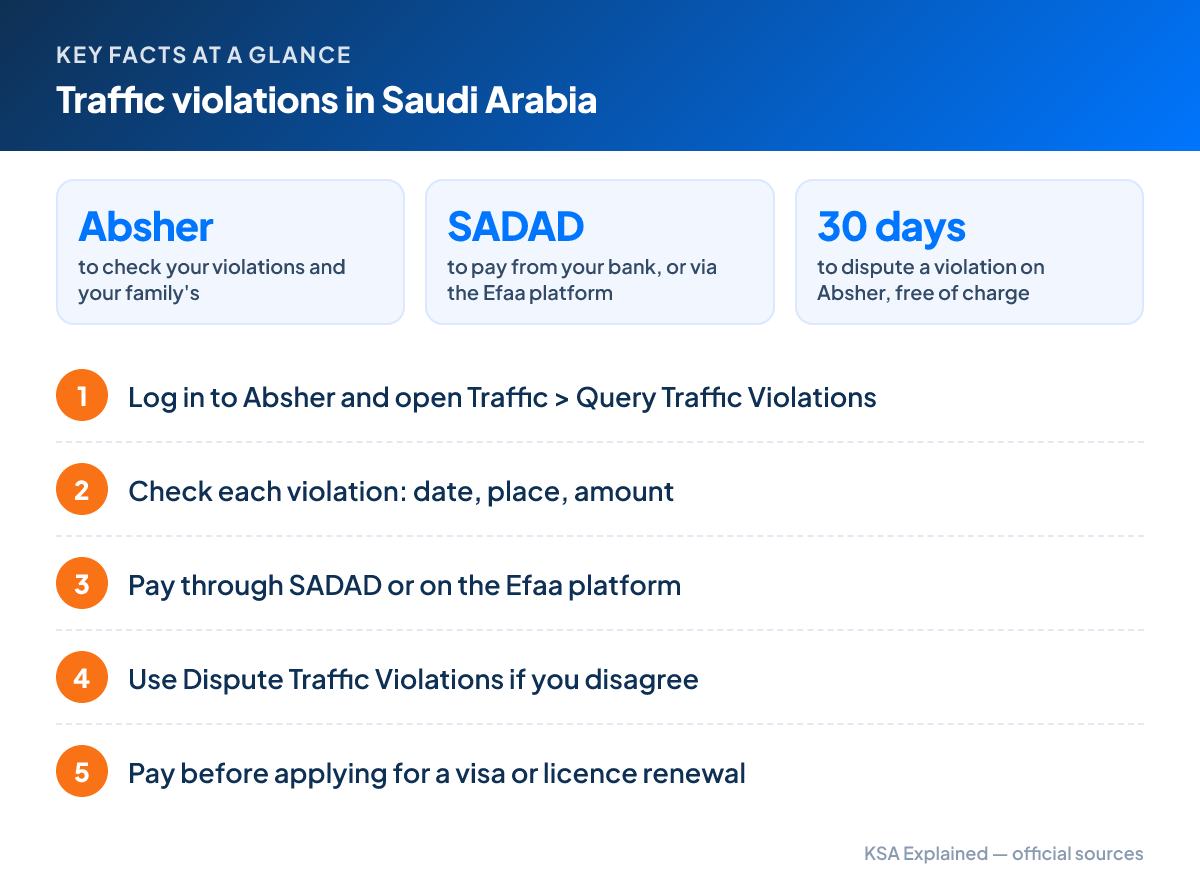
In short: check your violations on Absher, pay them through SADAD or the Efaa platform, and dispute them within 30 days with the free Traffic Violation Objection service. Pay them before any visa or licence procedure.
The key deadlines
| Step | Deadline | Where |
|---|---|---|
| Dispute a violation | Within 30 days of the date it was recorded | Absher |
| Pay at the minimum amount | Within 30 days (for fines with a minimum and a maximum) | SADAD, Efaa |
| Extend the payment deadline | Before the deadline | Absher |
Checking your violations
On Absher (citizens and residents)
- Log in to Absher Individuals.
- Go to e-services > Queries > Traffic > Query Traffic Violations.
- The list shows your violations, and you can also check those of family members registered under you.
Without logging in
Absher’s public Query Traffic Violations page lets you search with your ID number and either the violation number or your date of birth (Hijri or Gregorian), after a verification code.
For visitors
Visitors can use Query Traffic Violations for Visitors, in Absher’s instant services: choose Visitors, enter the document number and click View. The unpaid violations are listed.
Tip: check your violations regularly, for example once a month. You will spot a violation while you can still dispute it, and pay it while the minimum amount applies.
Paying
Payment channels
- SADAD: violations can be paid from your bank’s app, website or ATM, in the government payments section.
- Efaa platform: the national platform lists a service to pay government violations registered against individuals. Choose Individuals, log in with the national single sign-on, view your violations and pay by SADAD or by Mada or credit card.
Once paid, check on Absher that the violation no longer appears as unpaid.
Minimum and maximum amounts
Many traffic fines are set as a range, with a minimum and a maximum. The Ministry of Interior states that citizens and residents who pay within 30 days pay the minimum value; after that period, the maximum value is due.
Example (illustrative amounts). A violation carries a fine ranging from SAR 300 to SAR 500. Paid within 30 days, it costs SAR 300; paid later, SAR 500.
Extending the payment deadline
Absher also has an Extending Payment Deadline service for traffic violations. Use it before the deadline if you cannot pay in time.
Disputing a violation
If you think a violation is wrong (wrong vehicle, wrong place, you were not the driver, wrong amount):
- Log in to Absher.
- Go to My Services > Traffic > Traffic Violation Objection.
- Select the violation, explain your reasons and follow the instructions.
The objection must be submitted within 30 days of the date the violation was recorded, and the service is free. It covers violations registered by the General Department of Traffic or any other authority applying the traffic law and its regulations.
Watch out: the 30 days run from the date the violation was recorded, not from the day you noticed it. Check Absher regularly so you do not miss the window.
Preparing your objection
- Note the violation number, date, time and place.
- Explain clearly why it is wrong: you sold the car before the date, the car was elsewhere, the plate was misread.
- Keep any evidence: sale documents, rental contract, photos, receipts showing where you were.
Why paying matters
Unpaid violations block several services:
| Service | Rule |
|---|---|
| Exit re-entry and final exit visas | All traffic violations of the traveller, and of the employer or family head, must be paid |
| Issue or renewal of a family member’s Iqama | The family member’s violations must be paid |
| Driving licence renewal | Violations must be settled before renewing |
| Family visit visa extension | No traffic violations may be registered against the visitor |
See exit re-entry visa, final exit visa and Saudi driving licence.
Violations that affect your employer or family
Traffic violations are not only a personal matter. The Absher guide makes the payment of violations a condition for several services requested by someone else on your behalf:
| Service | Whose violations must be paid |
|---|---|
| Exit re-entry or final exit visa | The traveller’s, and those of the employer or family head |
| Issuing an Iqama for a family member or domestic worker | The family member’s or worker’s |
| Renewing an Iqama | The person whose Iqama is renewed |
| Extending a family visit visa | The visitor’s |
| Final exit during probation for a domestic worker | The employer’s and the worker’s |
So an unpaid fine on the head of family’s record can block a dependant’s travel, and a worker’s unpaid fines can delay the employer’s procedures for that worker.
Tip: before any family trip, the head of family should check on Absher the violations of every family member, not only their own.
If you are a visitor
- Use Query Traffic Violations for Visitors with your document number (passport or visa).
- Pay any unpaid violation before leaving, through SADAD or the Efaa platform.
- If you rented a car, keep the rental contract: it shows who was driving the vehicle and when.
Other useful Absher traffic services
- Public Query Vehicle Insurance Validity: check that a vehicle is insured.
- Minor Accident Reporting: report a minor accident with a form.
- Accident Objection/Waiver: object to or waive the share of responsibility assigned in an accident.
- Impounded Vehicle Query: find out whether a vehicle has been impounded; the service covers more than 340 sites.
- Reporting Vehicle Plate Stealing or Loss and Report Stolen Vehicle: report a theft electronically, without delay.
- Electronic Bail for Traffic: create and view guarantees linked to traffic cases.
- Appointments Service: book an appointment at a traffic department when a visit is needed.
- Issue Authorization and Add Vehicle User: declare who drives your vehicle.
- Vehicle Ownership Transfer: sell a private vehicle electronically, useful before a final exit.
For an accident with injuries, call 997 or 911 first: see emergency numbers.
Common mistakes
- Waiting until the airport: check and pay violations well before travelling, as they block the visa.
- Missing the 30-day window: after it, the objection is no longer possible and the fine may rise to its maximum.
- Paying the wrong record: check the violation number before paying.
- Lending your car without declaring the driver: use the authorisation services so that the actual user is recorded.
Frequently asked questions
How do I check my traffic violations in Saudi Arabia?
On Absher: log in, then go to the e-services, Queries, Traffic and Query Traffic Violations. The same service shows the violations of family members registered under you.
Can a visitor check traffic violations?
Yes. Absher has a Query Traffic Violations for Visitors service in its instant services: you enter the document number and the list of unpaid violations is displayed.
How do I pay a traffic violation?
Through the SADAD system from your bank, or on the Efaa platform for government violations, by logging in with the national single sign-on and paying by SADAD or card.
Can I dispute a traffic violation?
Yes. On Absher, go to My Services, Traffic, Traffic Violation Objection. The objection must be submitted within 30 days of the date the violation was recorded, and the service is free.
Do unpaid violations block an exit re-entry visa?
Yes. The Absher guide lists payment of all traffic violations as a condition for issuing an exit re-entry or final exit visa.
Is there a deadline to pay a traffic fine?
Many fines have a minimum and a maximum amount. The Ministry of Interior states that paying within 30 days allows paying the minimum value; after that, the maximum value is due. Absher also has a service to extend the payment deadline.
Can I check the traffic violations of my wife or children?
Yes. The Query Traffic Violations service on Absher also shows the violations of family members registered under the head of family.
My car was impounded. How do I find it?
Absher has an Impounded Vehicle Query service that checks impounded vehicles across more than 340 sites in Saudi Arabia.
Official sources
- Absher — Dispute Traffic Violations, frequently asked questions: path on Absher, 30 days from recording, free service.
- Absher — Traffic services: query, visitors’ query, dispute, payment deadline extension and other traffic services.
- Absher — Query Traffic Violations: public query by ID and violation number or date of birth.
- GOV.SA — Query Traffic Violations: steps on Absher, family members.
- GOV.SA — Query Traffic Violations for Visitors: steps for visitors.
- GOV.SA — Payment of government violations registered against individuals: payment on the Efaa platform by SADAD, Mada or card.
- Ministry of Interior — Traffic Violations & Penalties: minimum value within 30 days, maximum after.
- Absher — Individuals e-services user guide (2022): payment of violations required for visas, Iqamas and visit visa extensions.
This information is for guidance only and may change. Always check with the relevant authority or its official website before starting a procedure. Spotted an error? Tell us.